
The Scholar and the Parcharakh
After the transformation at Lahore, Prithipal Singh began a new life of learning, preaching and service. His earlier scholarship became part of the way he communicated the teachings of Guru Nanak to Sikh congregations.
When Scholarship Became Seva
The surviving family recollections describe Prithipal Singh beginning a life of travelling lectures after joining the Sikh congregation. He moved from town to town and gurdwara to gurdwara, speaking about Guru Nanak’s spiritual teachings, the oneness of God and the principle of love for humanity.
From Seeker to Teacher
The previous chapters followed Mushtaq Hussain Shah through his education, his journey to Makkah and Medina, the discovery of the manuscript attributed to Taajudin, and his subsequent search for understanding.
After his initiation into the Sikh tradition and his adoption of the name Prithipal Singh, the direction of his life changed. The sources describe him as dedicating himself to the service of the Panth and to communicating Guru Nanak’s teachings.
This was not presented as a short period of interest. According to his son’s recollections, his father continued preaching Guru Nanak’s mission through lectures for the remainder of his life.
Guru Nanak’s Message
In the family recollection, Prithipal Singh’s lectures focused particularly on the spiritual teachings of Guru Nanak, the oneness of God and love for humanity.
Arabic, Persian and Sikh Learning
Prithipal Singh entered Sikh public life with an unusual educational background. His earlier studies had included Islamic scholarship, Arabic and Persian learning, and medical training.
His knowledge of the Islamic intellectual world became particularly relevant to his continuing interest in Guru Nanak’s journeys through the Middle East. His later writings on the Taajudin material contain extensive references to Arabic and Persian traditions.
Arabic
His earlier Islamic education gave him familiarity with Arabic religious and scholarly material.
Persian
Persian sources and terminology became important in his later study of historical accounts concerning Guru Nanak’s travels.
Gurbani
After joining the Sikh tradition, he developed his understanding of Gurbani and communicated Sikh teachings to congregations.
From Gurdwara to Gurdwara
Professor Mohinder Pal Singh Bedi’s recollections describe the family as having no fixed home during the early years of Prithipal Singh’s Sikh missionary work.
His father travelled from one town to another and from one gurdwara to another, delivering lectures and spreading what the family account calls Guru Nanak’s mission.
This travelling lifestyle was closely connected with his livelihood. In his own autobiographical preface, Sant Ji later explained that, because he had no other income, he supported his family through singing the praises of the Guru and moving between gurdwaras.
“My father had embarked upon a mission to spread Guru Nanak’s Doctrines.”
Professor Mohinder Pal Singh Bedi, recollections of his fatherA Life on the Move
Lahore and Dera Sahib
The surviving accounts place the transition to Sikhism at Dera Sahib in Lahore during the early-to-mid 1930s. The precise year remains disputed between the surviving accounts.
Beginning of Parchar
Family recollections describe Prithipal Singh beginning to travel between towns and gurdwaras, speaking about Guru Nanak’s teachings.
A Major Family Change
According to his son’s recollections, his first wife Inderjeet Kaur, née Syed Gulzar Begum, died at Panja Sahib in 1934. He subsequently married Mata Raj Kaur.
Settlement in Amritsar
The family recollection records 1940 as the year when the family finally settled in Amritsar after years of travelling.
Move to Patiala
In 1946, the family moved from Amritsar to Patiala, which later became closely associated with Sant Ji’s family and public identity.
Making Guru Nanak’s Message Understandable
The family recollections emphasize that Prithipal Singh’s lectures centred on Guru Nanak’s spiritual teachings. His background meant that he could approach the subject from a perspective familiar with both Sikh and Islamic intellectual traditions.
His interest in Guru Nanak’s conversations with Pirs and Hazrats during the journeys through the Middle East became especially important to his later lectures and writings.
The Islamic World
His previous education gave him a foundation for discussing Arabic and Persian terminology, texts and religious traditions appearing in the material he studied.
The Sikh Tradition
His later Sikh scholarship enabled him to explain Guru Nanak’s teachings to Sikh congregations and connect historical narratives with Sikh spiritual thought.
One God and Love for Humanity
According to Professor Mohinder Pal Singh Bedi’s recollections, his father’s lectures repeatedly returned to Guru Nanak’s teachings concerning the oneness of God and love for humanity.
This became one of the defining themes of his public work. The same universal emphasis can also be seen in the later manuscript material attributed to Sant Ji, where Guru Nanak’s encounters with people from different religious backgrounds are repeatedly discussed.
“One God and love of humanity”
Theme identified in Professor Mohinder Pal Singh Bedi’s recollections of Sant Ji’s lecturesThe Man Behind the Mission
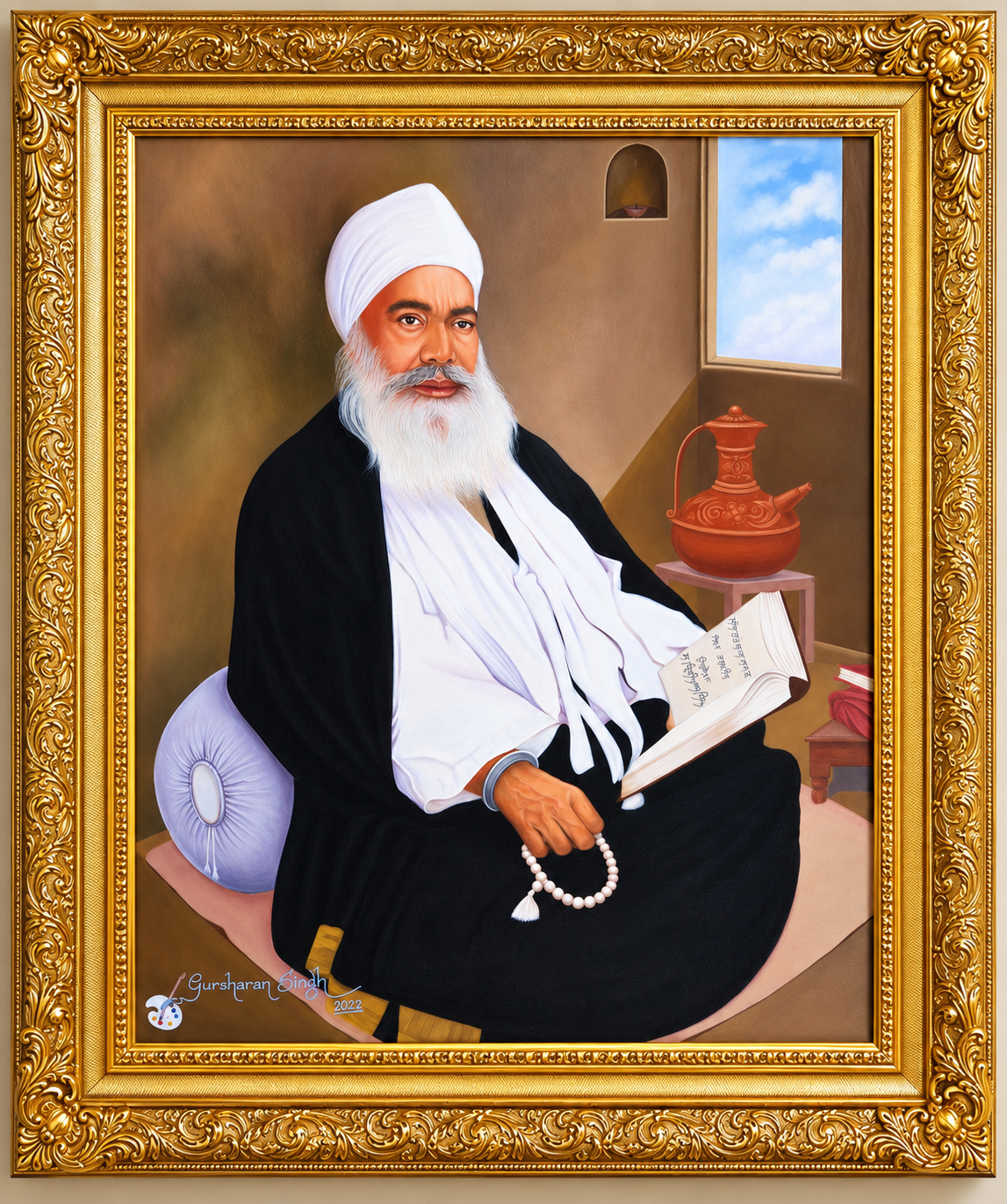
The photograph belongs to the later public identity of Sant Syed Prithipal Singh Ji. This chapter places it alongside the story of the earlier years when that identity was being formed through study, preaching and service.
From Oral Parchar to Written Record
Prithipal Singh’s work was not limited to public lectures. His later manuscripts became an important part of the archival record of his research into Guru Nanak’s travels and the Taajudin tradition.
According to the published material, Sant Ji prepared a substantial Punjabi manuscript in 1951 based on his research and notes. Portions were later published and translated, while the larger manuscript remained an important family-held archival resource.
This written work would eventually become one of the principal sources through which later generations encountered his interpretation of Guru Nanak’s journeys in the Islamic world.
The Scholar Becomes an Archivist
His lectures preserved ideas in the memories of listeners; his manuscripts preserved his research for future generations.
What the Sources Tell Us
✓ Travelling Parcharakh
Family recollections describe Prithipal Singh travelling from town to town and gurdwara to gurdwara to deliver lectures on Guru Nanak’s teachings.
✓ Scholar of Guru Nanak
His son recalled listening to his lectures from a young age and described his father’s deep understanding of Guru Nanak’s mission.
✓ Arabic & Persian Background
Sant Ji’s own autobiographical material records his earlier Islamic education, including his qualification as a Moulvi and his later use of Arabic-Persian sources.
⚠ Reconstructing the Early Years
The surviving accounts provide important recollections, but a complete year-by-year record of his early Parchar tours has not yet been established in the sources consulted.
The Foundation of a Lifetime of Service
The years following his initiation were formative. The historical record shows the emergence of a person who combined several strands of experience: a Muslim upbringing, Islamic scholarship, the discovery of material about Guru Nanak in Medina, study at Dera Sahib, Sikh initiation, and eventually public Sikh preaching.
His life as a Parcharakh would later take him far beyond the Punjab. The work begun in these early years eventually led to involvement in Sikh institutions, historical research, travel outside India and, ultimately, his work in Britain.
The next chapters therefore move from the formation of the scholar to his wider service to the Sikh Panth.
Sources for Chapter 7
Principal Sources
- Sant Syed Prithipal Singh, née Mushtaq Hussain Shah, Taajudin’s Diary , edited and translated by Inderjit Singh.
- Professor Himmat Singh, “A Brief Biography of Sant Syed Prithipal Singh” , included in the published edition of Taajudin’s Diary.
- Professor Mohinder Pal Singh Bedi, “My Recollections of my Father” , included in the published edition of Taajudin’s Diary.
- Sant Ji’s autobiographical preface, “About Me” , preserved in the same publication.
Archive note: This chapter distinguishes between Sant Ji’s own autobiographical material and later family recollections. Where the sources do not provide a complete chronology, the archive does not invent one.
Historical material presented for preservation, research and educational purposes.