The Search for Truth Mushtaq Hussain’s Questions After the Medina Discovery
The manuscript did not simply give Mushtaq Hussain a historical discovery. According to the later accounts of his life, it opened a deeper period of questioning, investigation and spiritual search.
When a Discovery Became a Question
In 1927, while studying in Medina, Mushtaq Hussain encountered a manuscript identified in Sant Syed Prithipal Singh Ji’s later account as Sihayto Baba Nanak Fakir. The discovery confronted a young Islamic scholar with an unexpected question: why was the life and message of Guru Nanak preserved in an Arabic-Persian account associated with the Muslim world?
From Reading to Reflection
Mushtaq Hussain had travelled to the Islamic holy cities with a strong educational purpose. His own later account describes his studies in Islamic scholarship and his desire to deepen his understanding of religious knowledge.
The manuscript he encountered in Medina presented him with material that he had not expected to find in that setting: an account of Guru Nanak’s travels and interactions with people of the Middle East.
According to the published account, this discovery became an important turning point in his intellectual and spiritual life. Rather than treating the manuscript as an isolated curiosity, he continued investigating the questions it raised.
Who Was Guru Nanak?
Why was Guru Nanak’s message being discussed within an Arabic-Persian historical and religious context?
What Did He Teach?
What was the nature of the teachings attributed to Guru Nanak, and why had they reached audiences beyond the Punjab?
What Was the Evidence?
Could the manuscript and other historical sources help him understand the accounts he was reading?
A Young Scholar Confronts an Unexpected Tradition
Mushtaq Hussain came from a respected Muslim family in the Mirpur region of Kashmir. His father, Pir Muzaffar Hussain Shah, is described in Sant Ji’s autobiographical account as a scholar and Pir, while his grandfather Pir Bakur Ali Shah is described as having served as a senior minister in the court of Maharaja Pratap Singh of Kashmir.
His own educational background was therefore deeply connected with Islamic learning. The published biography states that he had graduated as a Moulvi from Darul Uloom Deoband and had also trained in naturopathic medicine at Azmalkhan’s Tibbia College in Delhi.
Against this background, the encounter with a manuscript about Guru Nanak was particularly significant. It was not merely an encounter between two religious traditions; it became part of Mushtaq Hussain’s own search for understanding.
“During his search for truth, Mushtaq chanced upon a manuscript on the travels of Guru Nanak Dev ji in a library in Medina.”
Published account introducing Taajudin’s DiaryThis description is important because it places the manuscript discovery within a wider process of searching. The later published material portrays Mushtaq Hussain not simply as someone who found an old document, but as someone whose encounter with it intensified his questions about religious knowledge, spiritual practice and truth.
The Search Expanded
The later published account connects Mushtaq Hussain’s investigation with additional Arabic and Persian sources concerning Guru Nanak’s travels.
One source discussed in the material is Twarikhe Arab, attributed to Zainul Abidin of Makkah. The account states that in 1929 Mushtaq Hussain met Mehboob Rehman in Makkah, described as a descendant of Zainul Abidin.
Another work identified in the published material is Guniya-Ut-Salehin, associated with Pir Abdul Rehman of Baghdad.
These references should be understood as part of the documentary tradition preserved in Sant Ji’s later writings. They should not automatically be treated as independently authenticated historical manuscripts without further archival verification.
A Period of Investigation
Hajj and Medina
Mushtaq Hussain accompanied his father on Hajj and continued to Medina. While pursuing Islamic studies, he encountered the manuscript later identified as Sihayto Baba Nanak Fakir.
Questions Become a Search
The published accounts describe the manuscript as having a profound effect on him. His interest in Guru Nanak’s teachings and travels became part of a wider investigation into the sources available to him.
Further Inquiry in Makkah
The published Taajudin material records a further encounter in Makkah with Mehboob Rehman, connected in that account with the tradition of Zainul Abidin.
What Did Mushtaq Hussain See?
Sihayto Baba Nanak Fakir
In Sant Syed Prithipal Singh Ji’s account, this was a handwritten Arabic-Persian manuscript associated with Taajudin Naqshbandi and describing Guru Nanak’s travels through parts of the Middle East.
The account says that Taajudin accompanied Guru Nanak for a period, later returned to Medina, completed his manuscript and entrusted it to a library there.
The present location of the original manuscript has not been established in the sources used for this chapter.
What Attracted Him to Guru Nanak’s Message?
The surviving published accounts describe Mushtaq Hussain’s response as more than historical curiosity. The message he encountered in the material about Guru Nanak led him to investigate questions of spirituality, religious authority, human equality and the relationship between outward religious practice and inner transformation.
Later accounts describe Guru Nanak’s interactions with Muslim scholars, religious leaders and ordinary people in the Middle East. For Mushtaq Hussain, who was himself trained in Islamic scholarship, this created a particularly significant field of inquiry.
The important point for this chapter is not to impose a modern interpretation on his motives. His later writings and the biographies based on them provide the evidence that the encounter contributed to a continuing search that eventually brought him into direct contact with Sikh institutions and teachers in Lahore.
Preserving the Story of the Seeker
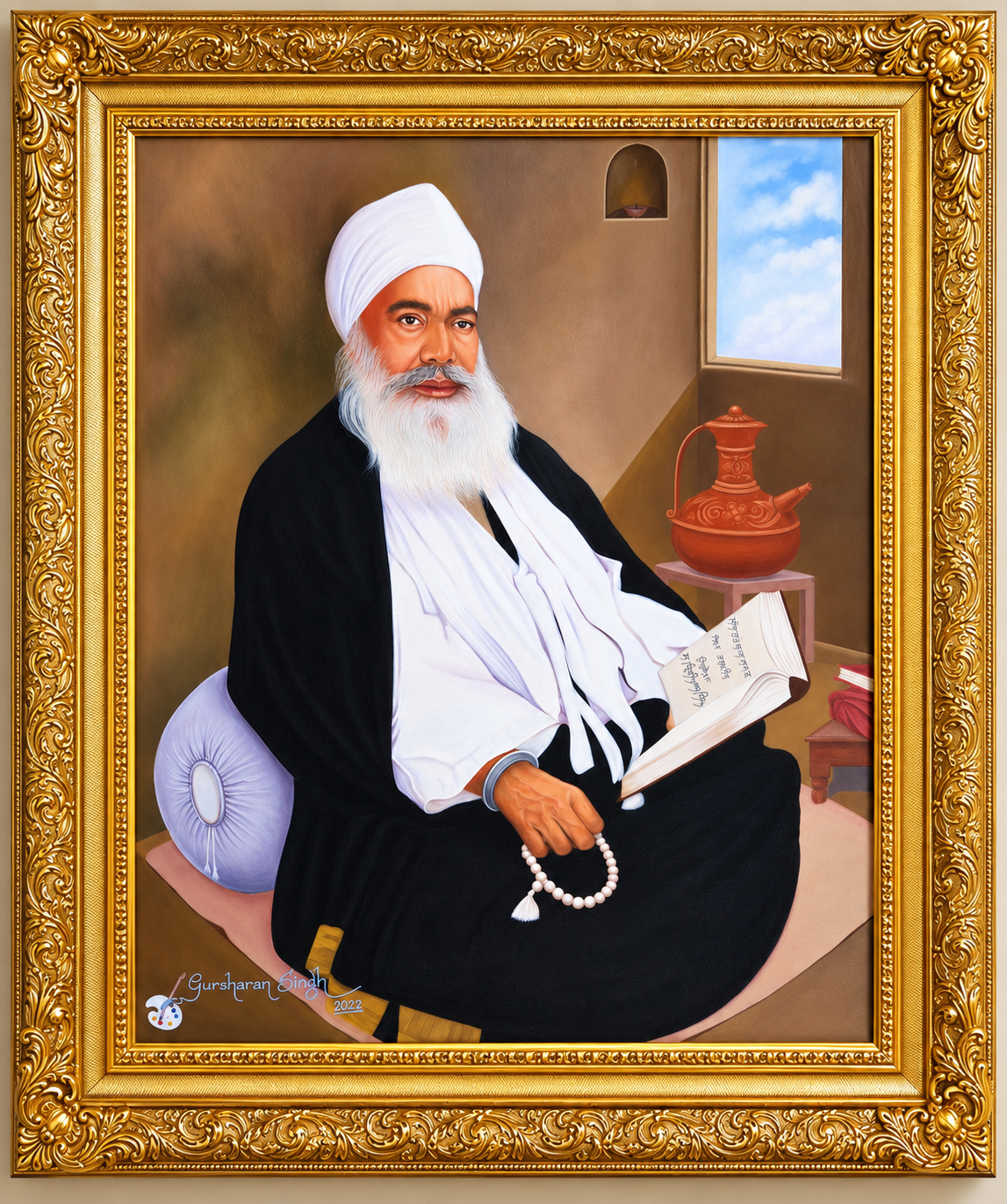
This portrait represents the later life of the man who had once been known as Mushtaq Hussain Shah. The purpose of this chapter is to preserve the earlier stage of his journey: the questions that emerged before his life became publicly associated with the name Sant Syed Prithipal Singh Ji.
What the Sources Establish — and What They Do Not
✓ Supported by the Published Account
The published biography identifies Mushtaq Hussain as a Muslim scholar from Kashmir who travelled with his father for Hajj in 1927 and subsequently studied in Medina.
✓ The Medina Discovery
Sant Ji’s later account identifies a manuscript called Sihayto Baba Nanak Fakir and associates its discovery by Mushtaq Hussain with Medina in 1927.
⚠ Manuscript Provenance
The present whereabouts and independently verifiable chain of custody of the original manuscript have not been established in the sources used here.
⚠ Later Interpretation
Statements about the manuscript’s historical authenticity, exact provenance or independent corroboration should be presented as research questions unless supported by additional archival evidence.
From Medina to Lahore
The Medina encounter did not immediately complete Mushtaq Hussain’s journey. According to the biographical accounts, his search continued after returning to the Indian subcontinent.
Eventually, his path brought him to Lahore, where he began visiting Gurdwara Dera Sahib, the historic site associated with the martyrdom of Guru Arjan Dev Ji. There he encountered Sikh teachings more directly and came into contact with Giani Achhar Singh.
This next period is crucial because it moves the story from discovery to direct engagement: from reading about Guru Nanak to studying Sikh teachings within the Sikh community itself.
The details of this transition are the subject of the next chapter.
Sources for Chapter 5
Principal Sources
- Sant Syed Prithipal Singh, née Mushtaq Hussain Shah, Taajudin’s Diary, edited and translated by Inderjit Singh. The publication contains Sant Ji’s autobiographical material and the account of the Medina manuscript.
- Professor Himmat Singh, “A Brief Biography of Sant Syed Prithipal Singh”, included in the published edition of Taajudin’s Diary.
- Professor Hardev Singh Virk, “Taajudin Diary: Travels of Guru Nanak to Mecca, Medina and Baghdad”, ResearchGate preprint. This is useful as a secondary research source but is identified by ResearchGate as a preprint and should not be treated as equivalent to a peer-reviewed study.
Archive note: Historical claims in this chapter are deliberately distinguished between Sant Ji’s own account, later biographical recollections and questions that require independent archival verification.
Historical material presented for preservation, research and educational purposes. “`